
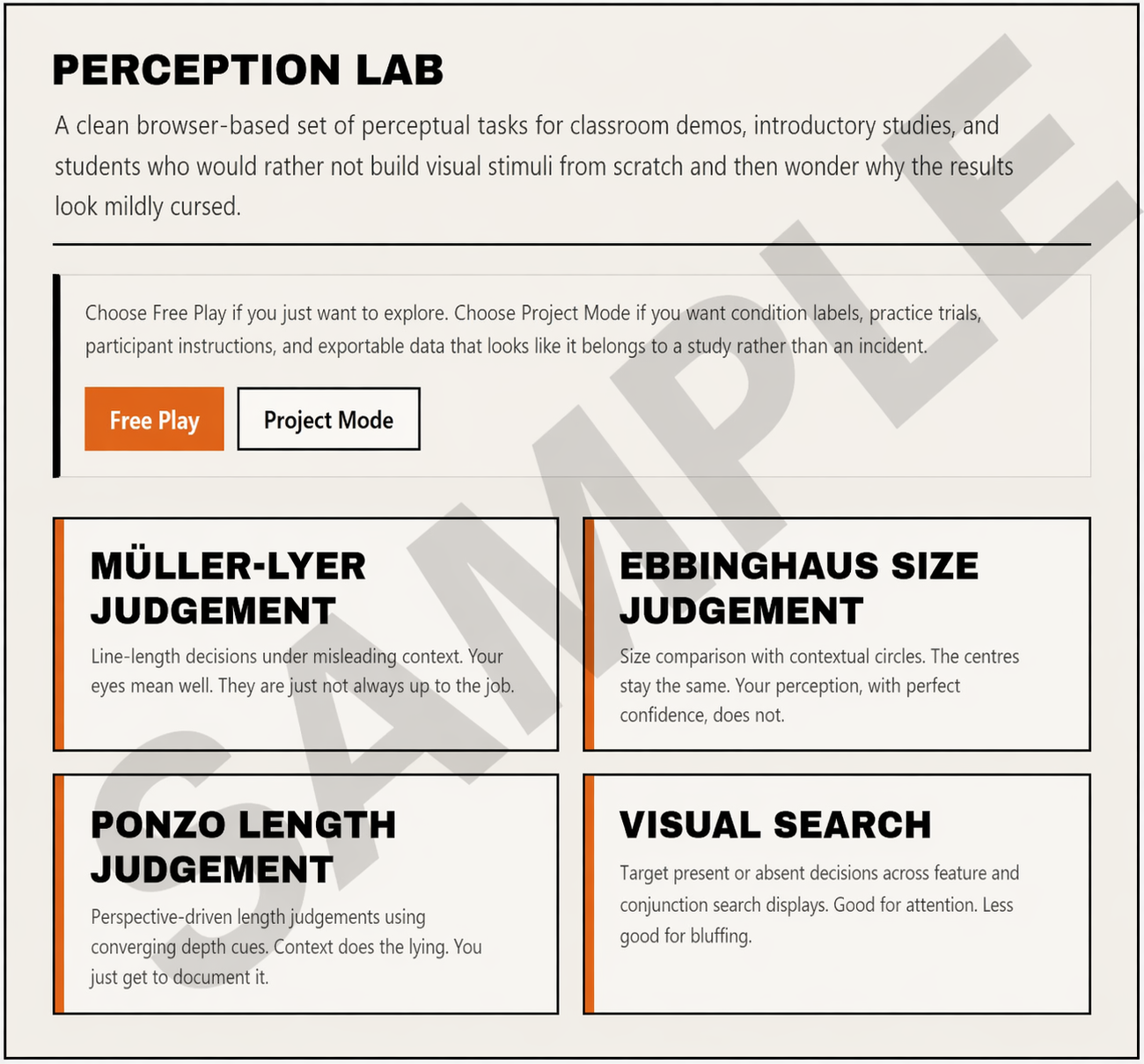
Browser-based perception software for students, teaching demos, and introductory research. Perception Lab is a browser-based psychology lab tool built for students, classroom demonstrations, and introductory research. It brings together a set of perceptual decision and discrimination tasks in one clean interface, designed for the kind of work that needs usable task data without specialist software installs, awkward setup, or a practical session held together by optimism alone.
Instead of cobbling together perception exercises from slides, screenshots, and improvised scoring, Perception Lab gives you a proper browser-based setup with Free Play for quick exploration and Project Mode for participant instructions, practice trials, condition labels, and export-ready CSV data.
What’s Included
Perception Lab is built around classic perceptual judgement tasks that let students work with how people identify, discriminate, and respond to visual information under different conditions.
Some tasks focus on discrimination, where participants decide which stimulus is brighter, clearer, larger, or otherwise more perceptually salient.
Others focus on identification, where participants classify or distinguish what they are seeing under conditions that may be more or less easy, ambiguous, or visually demanding.
Across the suite, the emphasis stays the same: clean perceptual tasks, manageable setups, and exportable data that can actually be used in coursework, teaching, and introductory research.
Why Use Perception Lab
Perception Lab is useful because perception is one of those topics that is easy to explain badly in theory and much better to show properly in practice. Students can read about perceptual bias, ambiguity, and stimulus discrimination all day, but it lands differently when they can actually run tasks, export the data, and see how performance shifts across conditions.
It also gives you more than one vague final score. The suite produces trial-by-trial CSV data, which means students can look at accuracy, reaction time, and error patterns rather than just claiming that one condition “seemed harder” and hoping that counts as analysis.
It is also cleaner than the usual alternative, which is trying to build perceptual tasks manually and then discovering halfway through that the method has become slightly ridiculous.
Who It’s For
Perception Lab is well suited to psychology undergraduates, sixth form and college teaching, university seminars, revision sessions, classroom demonstrations, and small student research projects. It works especially well for people who want practical perception tasks they can actually run, rather than just talking about visual processing in the abstract and calling it applied work.
It is also useful for tutors and lecturers who want something more structured than improvised practicals, and for students who need exportable data they can actually sort, compare, and write about.
How It Works
The lab runs in the browser. You choose a task, use Free Play if you want a quick run-through, or switch to Project Mode if you want participant instructions, practice trials, condition labels, and downloadable CSV results.
That means it works well both as a teaching tool and as a small research tool. You can demonstrate perceptual difficulty in class, compare conditions for coursework, or run a simple pilot study without spending more time building the task than using it.
What You Can Use It For
Perception Lab works well for perceptual decision tasks, stimulus discrimination studies, visual ambiguity teaching, accuracy and reaction time comparisons, and simple introductory perception research.
Common introductory designs include comparing easy versus ambiguous stimuli, high contrast versus low contrast, distraction versus no distraction, or one type of perceptual cue against another.
It is especially useful for undergraduate methods work because the logic is manageable, the tasks are practical, and the exported data gives students something better than a paragraph saying they think participants found one version harder.
What Your Download Includes
Each task produces trial-by-trial CSV data rather than one flattened final score. That means students can look at accuracy, reaction time, response choices, and error patterns depending on the task they used.
The product page also includes guidance on how to interpret the download, so students are not left staring at the spreadsheet as if perception itself has personally become unhelpful.
A Quick Note on Precision
Perception Lab is designed for teaching, demos, exploratory work, and introductory student research. It is useful, clean, and much easier to work with than building these tasks manually, but it is not intended to replace specialist experimental software in tightly controlled perceptual lab settings.
Very well suited to undergraduate work. For advanced perceptual precision, that is usually where the equipment gets fussier, the calibration gets more exacting, and everyone becomes strangely emotional about display settings.
Why It’s Worth Having
If you need one clean tool for browser-based perception tasks, this does the job properly. It is straightforward to run, easy to understand, and detailed enough to produce data that students can actually use rather than merely admire from a distance.
That is a much better arrangement than spending hours improvising a perception practical and then realising the method section reads like an apology.
Get Perception Lab and run browser-based perception tasks with export-ready study data.
Perception Lab
Perception Lab is a browser-based perceptual task tool for students, teaching demos, and introductory research. Run classic perception tasks, compare conditions, and export usable data without cobbling together visual stimuli by hand and then acting surprised when the whole thing goes strange.
It includes four core tasks in one clean interface: Müller-Lyer Judgement, Ebbinghaus Size Judgement, Ponzo Length Judgement, and Visual Search. Use Free Play to explore the tasks quickly, or switch to Project Mode for participant instructions, practice trials, condition labels, and export-ready results.