
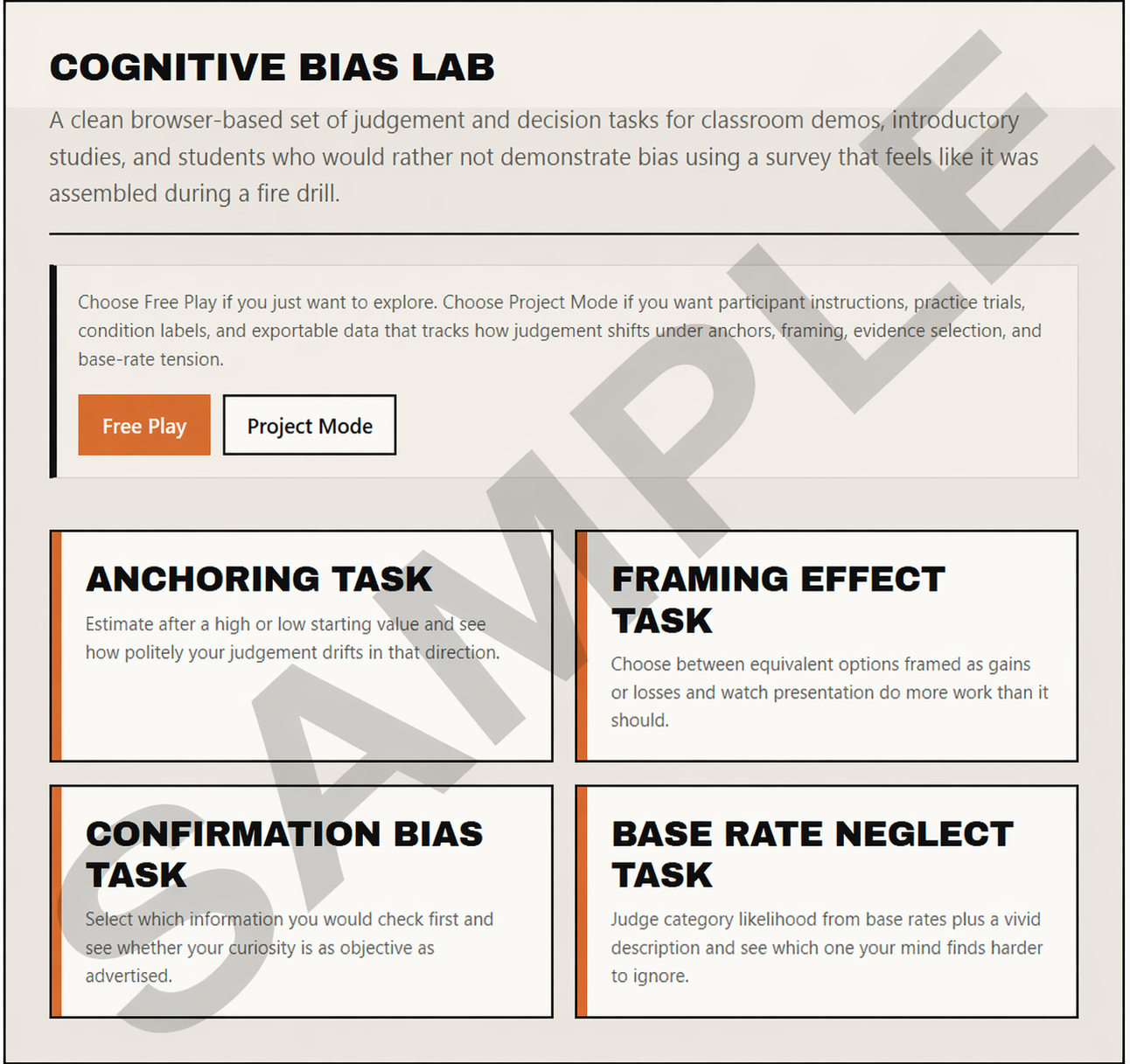
Browser-based cognitive bias software for students, teaching demos, and introductory research. Cognitive Bias Lab is a browser-based psychology lab tool built for students, classroom demonstrations, and introductory research. It brings together four classic judgement and decision tasks in one clean interface: Anchoring Task, Framing Effect Task, Confirmation Bias Task, and Base Rate Neglect Task.
What’s Included
Instead of cobbling together examples from lecture slides, improvised vignettes, and whatever survey builder happens to be open, Cognitive Bias Lab gives you a proper browser-based setup with Free Play for quick exploration and Project Mode for participant instructions, practice trials, condition labels, and export-ready CSV data.
Anchoring Task measures how initial values shape later estimates. Participants judge whether a value is higher or lower than an anchor, then give their own estimate, making it useful for showing how starting points quietly pull judgement in their direction.
Framing Effect Task measures how equivalent outcomes are judged differently depending on presentation. Participants choose between safe and risky options in gain and loss frames, allowing you to compare how framing shifts decision preferences.
Confirmation Bias Task measures evidence selection. Participants choose which piece of information they would check first when testing a claim, making it useful for showing how people often prefer information that supports what they already suspect.
Base Rate Neglect Task measures how category judgements are shaped by statistical context versus vivid descriptions. Participants choose which category seems more likely overall, allowing you to compare responses driven by the broader base rate with responses pulled by the more psychologically colourful cue.
Why Use Cognitive Bias Lab
Cognitive Bias Lab is built for the point where reading about cognitive bias is no longer enough and you actually need to run something. It gives students and tutors a practical way to work with classic judgement and decision tasks without needing specialist software or a lot of improvised materials that look educational until you actually try to use them.
It is useful because it does not flatten everything into one final score. It gives you trial-by-trial CSV data that you can sort, compare, and use in actual coursework or teaching. That means bias and judgement studies stop being something students only talk about in theory and start becoming something they can run, export, and interpret properly.
It also helps that the suite stays coherent. All four tasks are about how judgement shifts under anchors, framing, selective evidence seeking, or vivid descriptive cues. So it feels like one proper toolset rather than four unrelated teaching gimmicks tied together with optimism.
Who It’s For
Cognitive Bias Lab is well suited to psychology undergraduates, sixth form and college teaching, university seminars, revision sessions, classroom demonstrations, and small student research projects. It works especially well for people who want practical judgement and decision tasks they can actually run, rather than just repeating the same classic bias examples and hoping that counts as applied work.
It is also useful for tutors and lecturers who want something cleaner than improvised practicals, and for students who need exportable data they can actually use in a write-up.
How It Works
The lab runs in the browser. You choose a task, use Free Play if you want a quick run-through, or switch to Project Mode if you want participant instructions, practice trials, condition labels, and downloadable CSV results.
That means it works well both as a teaching tool and as a small research tool. You can demonstrate a framing effect in class, run a simple anchoring comparison for coursework, or test evidence selection and base-rate judgement without spending more time building the task than using it.
What You Can Use It For
Cognitive Bias Lab works well for judgement and decision-making studies, cognitive bias teaching, framing demonstrations, anchoring experiments, evidence selection tasks, and simple introductory reasoning research.
Common introductory designs include time pressure versus reflection time on anchoring, gain versus loss framing in risky choice, individual versus paired responding on confirmation bias, and distraction or prior warning effects on base-rate judgements.
It is especially useful for undergraduate methods work because the designs are manageable, the tasks are recognisable, and the exported data is detailed enough to be useful without becoming a small administrative nightmare.
What Your Download Includes
Each task produces trial-by-trial CSV data rather than one flattened final score. That means students can look at anchor shift, risky choice rates, confirming versus disconfirming evidence selections, base-rate consistency, and response times depending on the task they used.
The product page also includes guidance on how to interpret the download, so students are not left staring at the CSV as if one magical bias score is going to reveal itself if they just wait long enough.
A Quick Note on Precision
Cognitive Bias Lab is designed for teaching, demos, exploratory work, and introductory student research. It is useful, clean, and much easier to work with than building these tasks manually, but it is not intended to replace specialist behavioural software in tightly controlled lab settings.
Very well suited to undergraduate work. For advanced lab precision, that is usually where the methods sections get longer, the designs get fussier, and everyone starts sounding oddly personal about decision noise.
Why It’s Worth Having
If you need one clean tool for browser-based judgement and decision tasks, this does the job properly. It is straightforward to run, easy to understand, and detailed enough to produce data that students can actually work with.
That is a better arrangement than spending hours assembling a homemade bias practical and then realising the task itself has become the strongest demonstration of poor judgement in the room.
Get Cognitive Bias Lab and run browser-based judgement and decision tasks with export-ready study data.

Cognitive Bias Lab
Cognitive Bias Lab is a browser-based judgement and decision task tool for students, teaching demos, and introductory research. Run classic cognitive bias tasks, compare conditions, and export usable data without reducing the whole thing to a survey that feels like it already knows the answer.
It includes four core tasks in one clean interface: Anchoring Task, Framing Effect Task, Confirmation Bias Task, and Base Rate Neglect Task. Use Free Play to explore the tasks quickly, or switch to Project Mode for participant instructions, practice trials, condition labels, and export-ready results.