
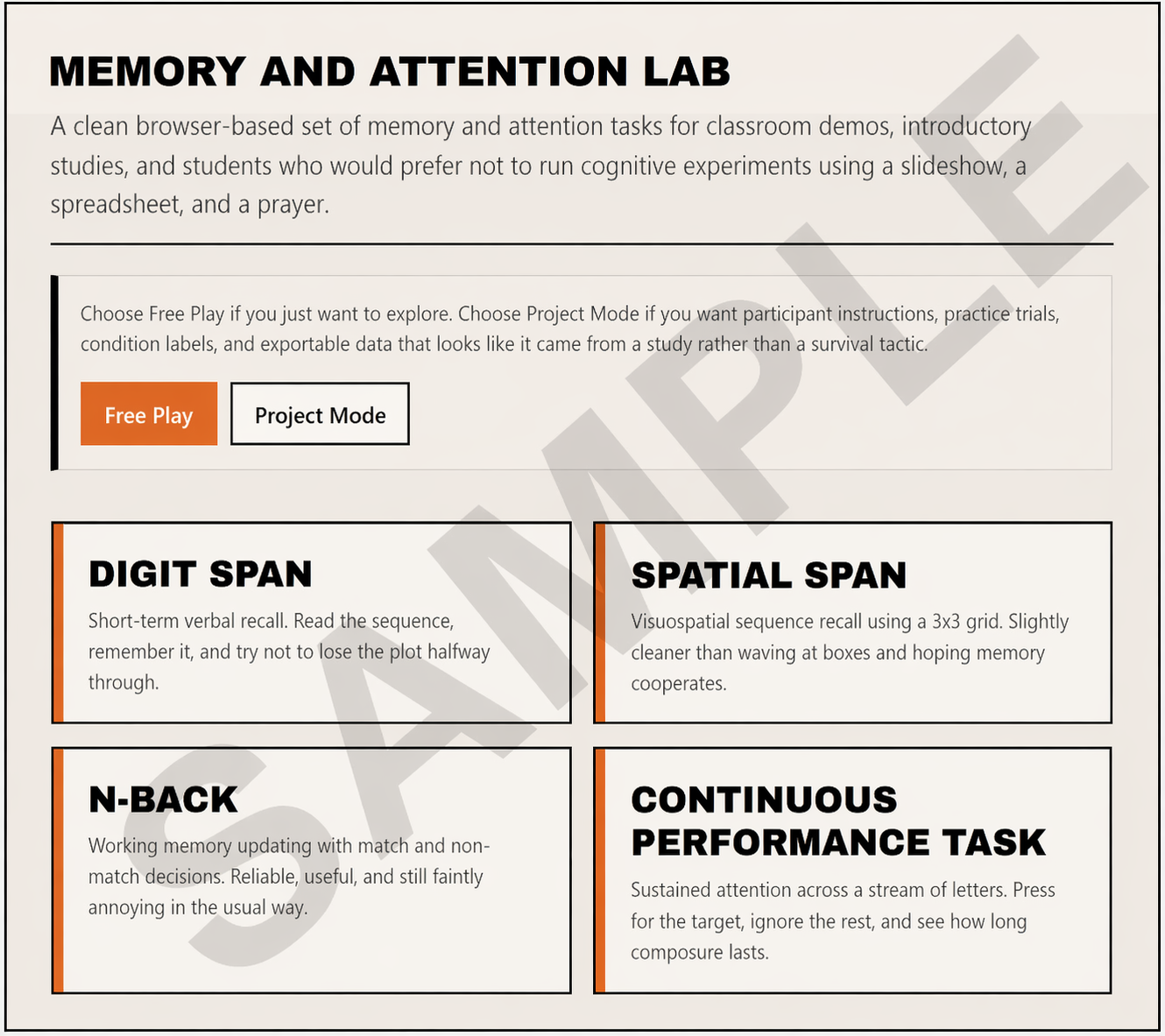
Browser-based memory and attention software for students, teaching demos, and introductory research. Memory and Attention Lab is a browser-based psychology lab tool built for students, classroom demonstrations, and introductory research. It brings together four classic cognitive tasks in one clean interface: Digit Span, Spatial Span, N-Back, and Continuous Performance Task.
It is designed for the kind of work that needs usable task data without specialist software installs, awkward setup, or a methods session held together by guesswork and caffeine.
Instead of piecing together memory and attention tasks from slides, manual scoring, and increasingly bad decisions, Memory and Attention Lab gives you a proper browser-based setup with Free Play for quick exploration and Project Mode for participant instructions, practice trials, condition labels, and export-ready CSV data.
What’s Included
Digit Span measures short-term verbal memory. Participants view a sequence of digits and recall them in the same order, making it useful for simple recall designs and introductory memory comparisons.
Spatial Span measures visuospatial memory. Participants watch a sequence of locations in a grid and reproduce the order, making it useful for classroom demonstrations and non-verbal memory work.
N-Back measures working memory updating. Participants decide whether the current item matches one presented earlier in the sequence, allowing you to examine hit rates, false alarms, and working memory load in a cleaner way than most improvised versions manage.
Continuous Performance Task measures sustained attention. Participants respond only to target stimuli and withhold responses to non-targets, making it useful for attention, vigilance, and response monitoring work.
Why Use Memory and Attention Lab
Memory and Attention Lab is built for the point where reading about these tasks is no longer enough and you actually need to run them. It gives students and tutors a practical way to work with classic memory and attention measures without needing specialist lab software or a heroic amount of patience.
It is useful because it does not just produce one vague final score. It gives you trial-by-trial CSV data that you can sort, compare, and use in actual coursework or teaching. That means memory and attention studies stop being something students only summarise in theory and start becoming something they can run, export, and interpret properly.
It also helps that the structure is consistent across the suite. Once you understand one task, the others are easy to pick up. Which is helpful, because methods work generally has enough unnecessary friction already.
Who It’s For
Memory and Attention Lab is well suited to psychology undergraduates, sixth form and college teaching, university seminars, revision sessions, classroom demonstrations, and small student research projects. It works especially well for people who want practical memory and attention tasks they can actually run, rather than just describing Digit Span or N-Back in an essay and hoping that counts as applied work.
It is also useful for tutors and lecturers who want something cleaner than improvised practicals, and for students who need exportable data they can actually use in a write-up.
How It Works
The lab runs in the browser. You choose a task, use Free Play if you want a quick run-through, or switch to Project Mode if you want participant instructions, practice trials, condition labels, and downloadable CSV results.
That means it works well both as a teaching tool and as a small research tool. You can demonstrate working memory in class, run a simple attention comparison for coursework, or test a basic recall idea without spending more time building the task than using it.
What You Can Use It For
Memory and Attention Lab works well for short-term memory tasks, working memory studies, attention and vigilance research, recall accuracy comparisons, and simple introductory cognitive research.
Common introductory designs include distraction versus no distraction on Digit Span recall, morning versus evening on Spatial Span accuracy, 1-back versus 2-back performance in N-Back, and fatigue or time-on-task effects in the Continuous Performance Task.
It is especially useful for undergraduate methods work because the tasks are familiar, the designs are manageable, and the exported data is detailed enough to be useful without becoming a spreadsheet-based punishment.
What Your Download Includes
Each task produces trial-by-trial CSV data rather than one flattened final score. That means students can look at recall accuracy, span length, hit rate, false alarm rate, omission errors, commission errors, and mean correct reaction time depending on the task they used.
The product page also includes guidance on how to interpret the download, so students are not left staring at the CSV as if every column is trying to mean the same thing. They are not.
A Quick Note on Precision
Memory and Attention Lab is designed for teaching, demos, exploratory work, and introductory student research. It is useful, clean, and much easier to work with than building these tasks manually, but it is not intended to replace specialist experimental software in high-precision lab settings.
Very well suited to undergraduate work. For advanced lab precision, that is usually where the software gets more expensive, the setup gets fussier, and everyone starts speaking as if timing drift is a personal betrayal.
Why It’s Worth Having
If you need one clean tool for classic browser-based memory and attention tasks, this does the job properly. It is straightforward to run, easy to understand, and detailed enough to produce data that students can actually work with.
That is a better arrangement than spending hours building a shaky version yourself and then discovering the write-up has become a long explanation of why the task was only half under control.
Get Memory and Attention Lab and run browser-based memory and attention tasks with export-ready study data.
Memory and Attention Lab
Memory and Attention Lab is a browser-based cognitive task tool for students, teaching demos, and introductory research. Run classic memory and attention tasks, compare conditions, and export usable data without patching together half a study from notes, guesswork, and whatever spreadsheet happens to be open.
It includes four core tasks in one clean interface: Digit Span, Spatial Span, N-Back, and Continuous Performance Task. Use Free Play to explore the tasks quickly, or switch to Project Mode for participant instructions, practice trials, condition labels, and export-ready results.