Most students do not really struggle with the idea of citation. They struggle with the tiny decisions around it. You know you need the source. You know the author and year have to appear somewhere. What keeps eating time is the irritating little question of where they should go. Do you write Bandura (1977) as part of the sentence, or do you leave it to the end as (Bandura, 1977)? The answer is not dramatic. Narrative citations place the author in the sentence and the date in parentheses, while parenthetical citations keep both author and date inside parentheses. Both are valid. The issue is not correctness versus incorrectness so much as fit and flow.
TL;DR
Use a narrative citation when you want the author to feel like part of the sentence. Use a parenthetical citation when the source supports the point but does not need starring billing. If you are citing multiple works together, parenthetical format is usually cleaner. If you are directly quoting, you still need the locator, such as a page number, whichever format you choose.
What the actual difference is
A narrative citation folds the author into the prose: Jones (2020) found... A parenthetical citation leaves the prose alone and tucks the source at the end: ...was associated with higher scores (Jones, 2020). That is the whole structural distinction. The punctuation changes with it too. In parenthetical citations, the author and year sit together in parentheses, separated by a comma. In narrative citations, the date follows the author in parentheses.
This sounds trivial until you realise it changes the tone of the sentence. Narrative citations make the writer sound as though they are actively engaging with a researcher or argument. Parenthetical citations make the claim sound more like your own sentence, quietly supported by evidence in the background. Neither is inherently better. They just do different rhetorical jobs. That is why students who use only one style for an entire paper often end up sounding either stiff or oddly repetitive.
When a narrative citation works better
Narrative citations are strongest when the author matters to the sentence. That usually happens in three situations.
The first is when you are discussing a theorist, a classic study, or a particular researcher’s argument. If the sentence is really about what Bandura argued, what Loftus found, or how Tajfel framed something, narrative form feels more natural because the person is part of the point.
The second is when you want smoother prose. Sometimes (Author, year) stuck at the end of every sentence makes the paragraph feel like it is stepping on rakes. Narrative citations let you vary the rhythm.
The third is when you are comparing scholars directly. Smith (2021) argues..., whereas Patel (2023) suggests... reads much more cleanly than trying to cram both moves into end-of-sentence brackets. This is one of those places where citation choice is really a writing choice pretending to be punctuation.
When a parenthetical citation works better
Parenthetical citations are better when the idea matters more than the name. If you are stating a fairly straightforward point and simply need to show it is grounded in evidence, the parenthetical format is cleaner. It supports the sentence without making the author the main event.
They are also much better for stacked support. If a sentence draws on several studies at once, it is usually tidier to place them together parenthetically and separate them with semicolons in alphabetical order. That avoids a sentence that sounds like you are introducing guests at a conference panel.
So this works well:
Sleep disruption is associated with poorer mood and attentional control in student samples (Adams et al., 2019; Shumway & Shulman, 2021).
Whereas forcing that into narrative form would make the sentence sound needlessly crowded.
The mistake students make most often
They treat narrative and parenthetical citation as though one is the “real” APA version and the other is a stylistic extra. It is not. Both are standard in-text citation formats. Good academic writing usually uses both, depending on what the sentence is trying to do.
The second mistake is using narrative citations so often that every sentence starts with a surname. That is how you end up with paragraphs that sound like a roll call. The opposite problem also happens. Some students use nothing but parenthetical citations, which can make the prose feel oddly detached and mechanically sourced. A decent paragraph usually mixes them, because not every sentence needs the same emphasis.
A quick way to decide
Ask yourself one plain question: Is this sentence about the author, or about the idea?
If it is about the author’s argument, finding, or position, narrative is often the better choice.
If it is mainly about the claim you are making, and the source is there to support it, parenthetical is often better.
That single question solves most of the dithering.
What happens with quotations
Quotations do not change the choice between narrative and parenthetical citation, but they do add one more requirement. If you quote directly, include a page number or another sensible locator. With a narrative citation, the author is part of the sentence and the year follows the name in parentheses, with the locator attached to the quotation. With a parenthetical citation, the author, year, and locator all appear together at the end. If the source has no page numbers, use another logical locator such as a paragraph or section.
So these are both fine:
Jones (1998) found that “students often had difficulty using APA style” (p. 199).
“Students often had difficulty using APA style” (Jones, 1998, p. 199).
The important part is not choosing one sacred format. It is making sure the locator is there when the wording is borrowed directly.
The tiny punctuation issues that keep tripping people up
This is where people start making citation look harder than it is.
For two authors, use and in narrative citations and & in parenthetical citations.
For multiple works in one parenthetical citation, separate them with semicolons and order them alphabetically.
For repeated narrative citations within the same paragraph, the year can sometimes be omitted after the first mention, but that relaxation does not apply to parenthetical citations, where the year stays in every time.
These are small rules, but they are the sort that make a paper look either controlled or faintly improvised.
Group authors, missing authors, and other small annoyances
If the author is a group or organisation, the same narrative-versus-parenthetical logic still applies. The group name can appear in the sentence or in parentheses, and if a group abbreviation is introduced first in a parenthetical citation, it appears in square brackets before the year.
If there is no named author, use the title instead. In the text, titles of books and reports are italicised; titles of articles, chapters, and webpages go in quotation marks. If there is no date, use n.d.
This is one of those areas where students often panic as though the whole referencing system has collapsed. Usually it has not. The source is just being awkward.
Bad versus better
A clunky paragraph often looks like this:
Research shows social media use can affect wellbeing. (Smith, 2021). Brown (2022) also found similar patterns. Patel (2023) found mixed evidence.
Nothing here is catastrophically wrong, but the rhythm is stiff and the first citation is punctuated badly.
A better version would be:
Research suggests that social media use can affect wellbeing (Smith, 2021), though the evidence is not entirely neat. Brown (2022) reported similar patterns, whereas Patel (2023) found more mixed results.
Same sources. Much less awkward.
The real point
Narrative versus parenthetical citation is not a deep philosophical divide. It is a control problem. Once you understand what each format does, citations stop feeling like random punctuation traps and start functioning as part of the writing. Narrative form helps when the scholar matters. Parenthetical form helps when the evidence matters more than the name. Good papers usually need both.
That is also why this is such a useful thing to get right early. In-text citation is one of those small technical areas that quietly shapes how polished the whole paper feels. When it is handled well, nobody notices. When it is handled badly, the prose starts sounding like it was assembled under fluorescent lighting with a rising sense of doom.
Stop Fiddling Around With Citation Punctuation
If you understand the source but keep losing time over whether the citation should be narrative or parenthetical, where the comma goes, whether to use and or &, or how et al. fits into the sentence, that is exactly the sort of low-level friction the In-Text Citation Converter is designed to remove.
The tool is part of Original Matter’s Writing Packavailable as a free bonus with our Complete Pack and is built to help psychology and social science students generate quick APA 7 parenthetical and narrative citations without getting dragged into punctuation trivia every five minutes.
Because the essay should really be about the argument. Not the part where you stare at (Jones & Smith, 2021) for thirty seconds wondering whether the ampersand has ruined your life.
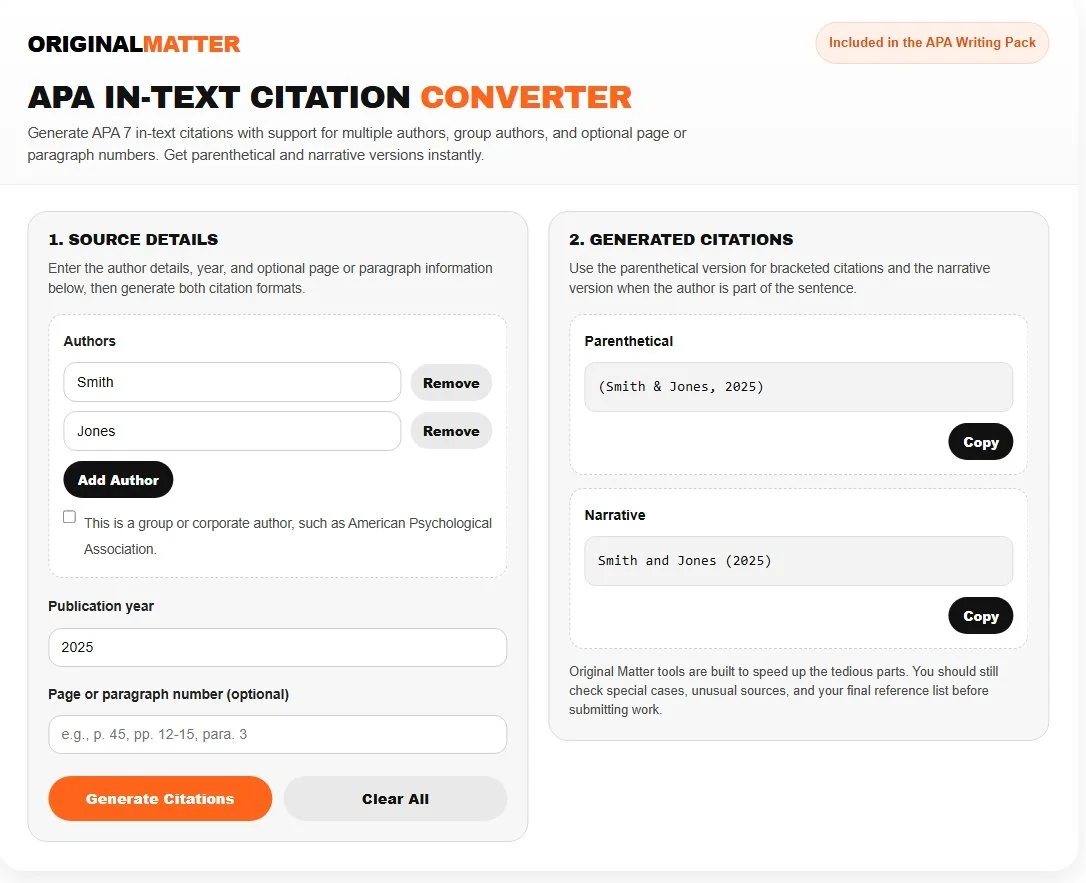
Our In-Text Citation Converter makes formatting a breeze, only available in our Complete Pack of academic tools