APA citation formatting has a way of making people feel stupid for no good reason. Most of the confusion comes from treating it like one giant rule when it is really two linked jobs. First, you cite the source in the body of your writing. Then you give the full source details in the reference list. APA uses an author-date system for in-text citations, and in general every work cited in the text should appear in the reference list as well.
Once you see that split clearly, APA becomes much easier to control. In-text citations tell the reader which source you are using at that moment. The reference list tells them exactly what that source is and where it came from. If one side is missing, the whole thing starts to wobble.
Start with the in-text citation
APA in-text citations usually follow the same core pattern: author plus year. You can do that in a narrative citation, where the author name appears as part of the sentence, or in a parenthetical citation, where both pieces sit in brackets at the end. For paraphrases, APA requires the author and year. Page numbers are not required for paraphrases, though APA says they can still be helpful. For direct quotations, the page number is required.
Example:
Narrative citation:
Smith (2024) argues that revision is often more important than first-draft fluency.
Parenthetical citation:
Revision is often more important than first-draft fluency (Smith, 2024).
Direct quotation:
“Revision is where weak reasoning usually gives itself away” (Smith, 2024, p. 18).
If your quotation runs to 40 words or more, APA treats it as a block quotation. That means you set it off from the main text, indent it, and drop the quotation marks. This is one of those rules that students vaguely remember half-correctly and then hope no one notices. Sadly, someone usually does.
One author, two authors, three or more
A source with one author is simple. Use the surname and year.
Smith (2024)
or
(Smith, 2024)
With two authors, name both authors every time you cite the source. In narrative citations, use “and.” In parenthetical citations, use an ampersand.
Smith and Jones (2024)
or
(Smith & Jones, 2024)
With three or more authors, APA 7 shortens the citation from the start. Use the first author’s surname followed by “et al.” in every in-text citation, including the first one.
Smith et al. (2024)
or
(Smith et al., 2024)
That is one of the easiest places to lose marks, mostly because older examples still float around online like ghosts from a previous edition.
What to do when information is missing
When a source has no date, APA uses “n.d.” for “no date.” When a source has no author, use the title in the citation instead. In the reference list, a title can move into the author position when no author is available. That sounds odd the first time you see it, but it is standard APA practice.
Examples:
No date:
(Smith, n.d.)
No author:
(“APA Formatting Basics,” 2025)
No author and no date:
(“APA Formatting Basics,” n.d.)
Citing more than one source at once
Sometimes you need to support one point with more than one source. In APA, when you place multiple works in one parenthetical citation, they should be listed in alphabetical order and separated with semicolons. It looks minor, but it is the kind of minor thing markers notice because they have seen the wrong version fifty times already.
Example:
Several studies make the same point about revision and clarity (Ahmed, 2021; Jones, 2019; Smith, 2024).
The reference list is where the detail lives
At the end of the paper, APA uses a reference list, not a vague pile of sources you meant well by. The page should begin on a new page with the heading References in bold and centred. The entries should be double-spaced, arranged alphabetically by the surname of the first author, and formatted with a hanging indent so the first line sits flush left and later lines tuck in underneath it. APA also frames most references around four core elements: author, date, title, and source.
There is also a basic matching rule worth keeping in your head: every source cited in the paper should appear in the reference list, and every entry in the reference list should be cited in the paper. The main exceptions are personal communications and certain kinds of general dictionary or classical material, which APA handles differently. For ordinary student writing, though, the match rule will keep you out of most trouble.
What Is a Hanging Indent in APA?
A hanging indent is one of those irritatingly small details that markers still notice. In an APA reference list, the first line of each reference sits flush with the left margin, while every line after that is indented by 0.5 inches. The idea is simple enough: it makes each entry easier to scan, especially when the reference runs over more than one line. APA 7 requires this format for reference entries, along with double spacing throughout the list.
Basic APA reference formats
The exact format changes depending on the source type, but the underlying logic stays pretty stable.
A journal article usually looks like this:
Author, A. A., & Author, B. B. (2024). Title of the article. Journal Title, 12(3), 45–58. https://doi.org/xxxxx
A book usually looks like this:
Author, A. A. (2024). Title of the book. Publisher.
A webpage usually looks like this:
Author or Organisation Name. (2024, March 10). Title of the page. Site Name. URL
The small details matter here. Article and webpage titles usually use sentence case. Journal titles use title case. Journal titles and volume numbers are italicised. Authors in the reference list appear surname first, then initials. For works with up to 20 authors, APA 7 includes all authors in the reference entry.
Common APA citation formatting mistakes
One very common mistake is mixing up citation and reference. The in-text citation is not supposed to carry the whole burden. Its job is just to point the reader to the full reference.
Another is using page numbers for every paraphrase as though APA demands it. It does not. They are mandatory for direct quotations, optional for paraphrases, and often useful when you want to help the reader find a precise point.
A third is mishandling author names. Students often use “et al.” for two-author sources, which is wrong in APA 7. Others use “and” inside brackets when APA wants an ampersand. Neither error is fatal, but both make the writing look sloppier than it needs to.
Then there is the classic reference list mess: no hanging indent, inconsistent capitalisation, titles in the wrong case, journal formatting done by vibes alone. At that point the issue is no longer understanding the source. It is just losing a fight with details.
Final thought
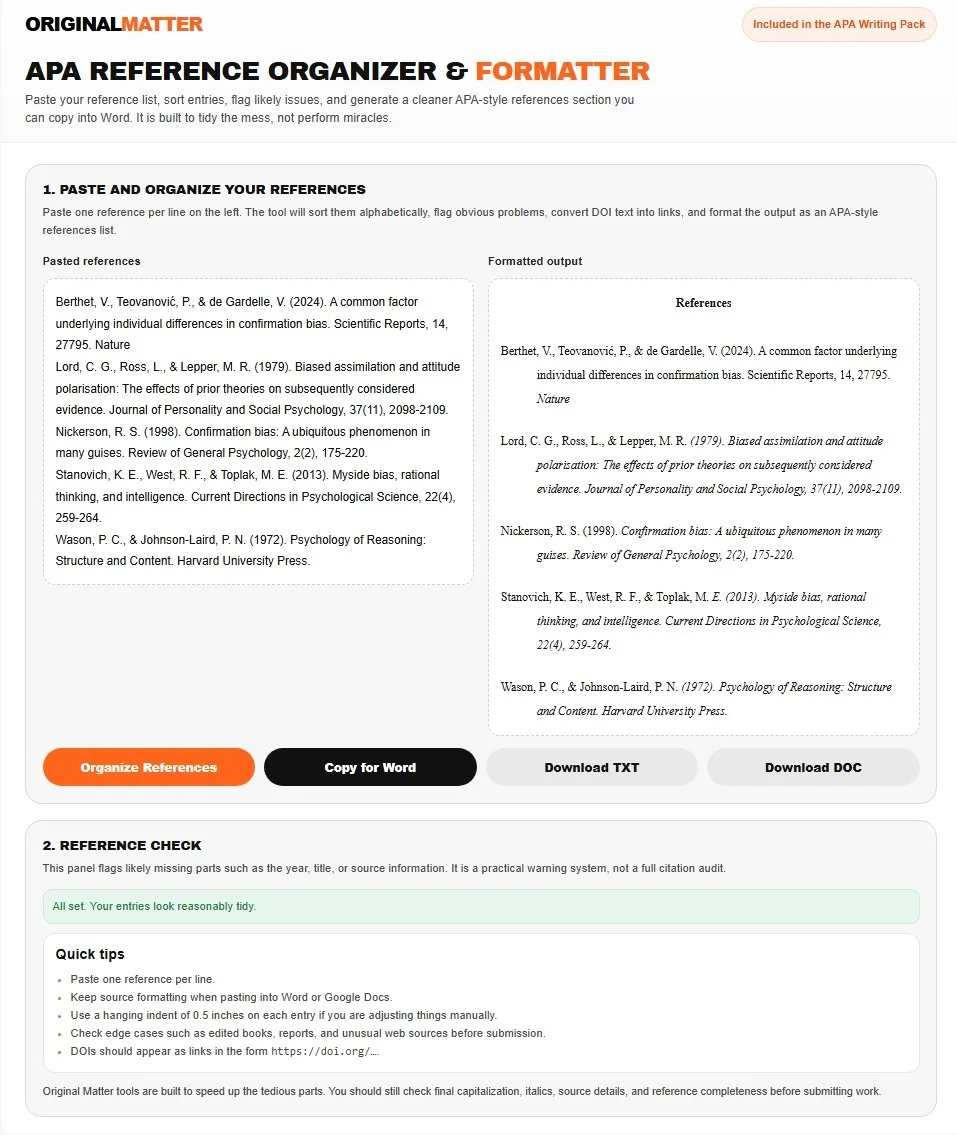
Our Complete Toolkit brings together Original Matter’scitation, reference, and formatting tools in one place, so you can spend less time wrestling with reference lists and more time finishing the work that actually matters
APA citation formatting is not difficult because the rules are deep. It is difficult because the rules are fiddly, repetitive, and easy to blur together when you are tired. That is why students end up making the same mistakes over and over. The fix is not mystical. Learn the basic pattern, keep the in-text citation and reference list doing their separate jobs, and check the details before you submit. Boring advice, admittedly, but boring advice has rescued many grades.
Stop Letting Your Reference List Ruin the Final Impression
Your sources may be solid, but if your references still look as though they were assembled during a mild emergency, that is exactly the kind of problem the Original Matter Complete Toolkit is built to solve.
The Reference Organizer & Formatter helps psychology and social science students tidy messy reference lists, sort entries, flag likely issues, and generate a cleaner APA-style references section without having to manually repair every line, and our In-Text Citation Converter tackles the other half of the same problem, because reference lists rarely go strange on their own. Usually the in-text citations have already started wandering off.
References
American Psychological Association. (n.d.). Basic principles of citation. APA Style.
American Psychological Association. (n.d.). Secondary sources. APA Style.
Purdue OWL. (n.d.). In-text citations: Author/authors. Purdue University.
Purdue OWL. (n.d.). Reference list: Other print sources. Purdue University.