APA in-text citations are usually manageable right up until more than one author appears. Then people start guessing. Some list every name forever. Some use et al. too early. Some switch between “and” and “&” as though punctuation is a matter of personal growth. None of this is rare. APA uses an author-date system, and the rule for multiple authors depends mainly on how many authors the source has.
Once you know the pattern, the whole thing becomes less dramatic. For a work with two authors, APA 7 says you should name both authors every time you cite the source. For a work with three or more authors, you use the first author’s surname followed by et al. from the very first citation onward. That is one of the clearest differences in APA 7, and one of the places students still get tripped up by older examples floating around online.
How to cite a source with two authors
Two-author citations are pleasantly unambitious. You include both surnames every time the source appears in your paper. In a narrative citation, use and. In a parenthetical citation, use &.
Examples:
Smith and Jones (2024) found that revision improved clarity in undergraduate writing.
(Smith & Jones, 2024)
Later in the same essay, you still cite both names:
Smith and Jones (2024) also argued that formatting errors often weaken otherwise solid work.
(Smith & Jones, 2024)
This is where people often go wrong. They treat two authors as though they can switch to et al. after the first citation. They cannot. APA wants both names every time.
How to cite a source with three or more authors
For three or more authors, APA 7 simplifies the citation straight away. You cite the first author’s surname followed by et al. in every in-text citation, including the first one.
Examples:
Patel et al. (2023) found that students often confuse citation rules with reference-list rules.
(Patel et al., 2023)
You do not need to write out all the names the first time. That was older APA practice, and it still lingers online like mould in the corners of student advice pages. APA 7 does not use that rule for works with three or more authors.
What et al. is doing, and what it is not doing
Et al. is just shorthand for the rest of the authors. It keeps citations readable when a source has three, four, or twelve names attached to it. In APA 7, its job is practical rather than decorative. You use it to shorten the in-text citation, not to avoid giving the full author list altogether. The complete author information still belongs in the reference list entry at the end of the paper. APA reference entries include up to 20 authors before special shortening rules apply.
So the in-text citation might look like this:
Garcia et al. (2022)
But the reference list would still give the author names in full, following APA reference rules. That mismatch is normal. It is not a sign that something has gone wrong.
What to do when two citations shorten to the same et al. form
This is where APA becomes mildly annoying again. Sometimes you have two different sources with three or more authors that would both shorten to the same citation. APA says that when different works collapse into the same et al. form, you should write out as many names as needed to distinguish them.
For example, these two sources would both become Taylor et al. (2021) if shortened carelessly:
Taylor, Ahmed, and Lin (2021)
Taylor, Ahmed, and Price (2021)
To avoid the collision, you would expand them enough to tell them apart in the text:
Taylor, Ahmed, and Lin (2021)
Taylor, Ahmed, and Price (2021)
Or in shortened form where possible, following APA’s distinction rule. The basic point is simple enough: if the short form creates confusion, APA wants you to restore enough names to remove it.
What to do when the author and year are the same
If you have multiple works by the same author or authors in the same year, APA adds a lowercase letter after the year. That means citations become things like 2022a and 2022b, and the same lettering should appear in the reference list.
Examples:
Morgan and Lee (2022a)
Morgan and Lee (2022b)
This looks small, but it stops two distinct sources from pretending to be one. Which, to be fair, is the sort of administrative problem citation styles were invented to inflict and then solve.
Common mistakes with multiple-author APA citations
The most common mistake is using et al. for a two-author source. APA does not allow that. Two authors means both surnames, every time.
Another common mistake is writing out all authors every time for a work with three or more authors. In APA 7, that is unnecessary in the in-text citation. You use the first author plus et al. from the start.
A third mistake is mixing up and and &. In narrative citations, use and because the authors’ names are part of the sentence. In parenthetical citations, use & because APA prefers the shorter symbol inside brackets. It is a small distinction, but it is one markers notice because it is very easy to get right once you know it.
Students also sometimes forget that a direct quotation still needs a page number, even when the citation involves multiple authors. The number of authors changes how the names appear, not the rule for quoting. APA still expects author, year, and page number for a direct quote.
And finally, there is the classic drift problem: the in-text citation and the reference list entry stop matching. APA’s own student checklist stresses that author names and publication dates in the text should match the corresponding reference entry. Once those start slipping apart, the whole paper begins to look less under control than it probably is.
Final thought
Multiple-author APA citations are not especially hard once the pattern settles in. Two authors means both names every time. Three or more authors means the first author plus et al. from the beginning. After that, most of the remaining trouble comes from collisions, repeated years, and tired formatting decisions made too close to the deadline. In other words, not a moral failing. Just admin with a university logo on it.
Stop Letting In-Text Citations Drift Off Course
If your argument is sound but your citations have started mutating halfway through the essay, that is exactly the sort of problem the Original Matter Complete Toolkit is built to deal with.
The In-Text Citation Converter helps psychology and social science students clean up citation formatting, handle awkward author combinations, and get closer to a consistent APA style without manually second-guessing every bracket. The Reference Organizer & Formatter handles the other half of the same mess, because in-text citations and reference lists have a habit of falling out of step together rather than separately.
By the time the writing is done, the last thing you need is another hour spent discovering that your authors, years, and references have quietly stopped agreeing with each other.
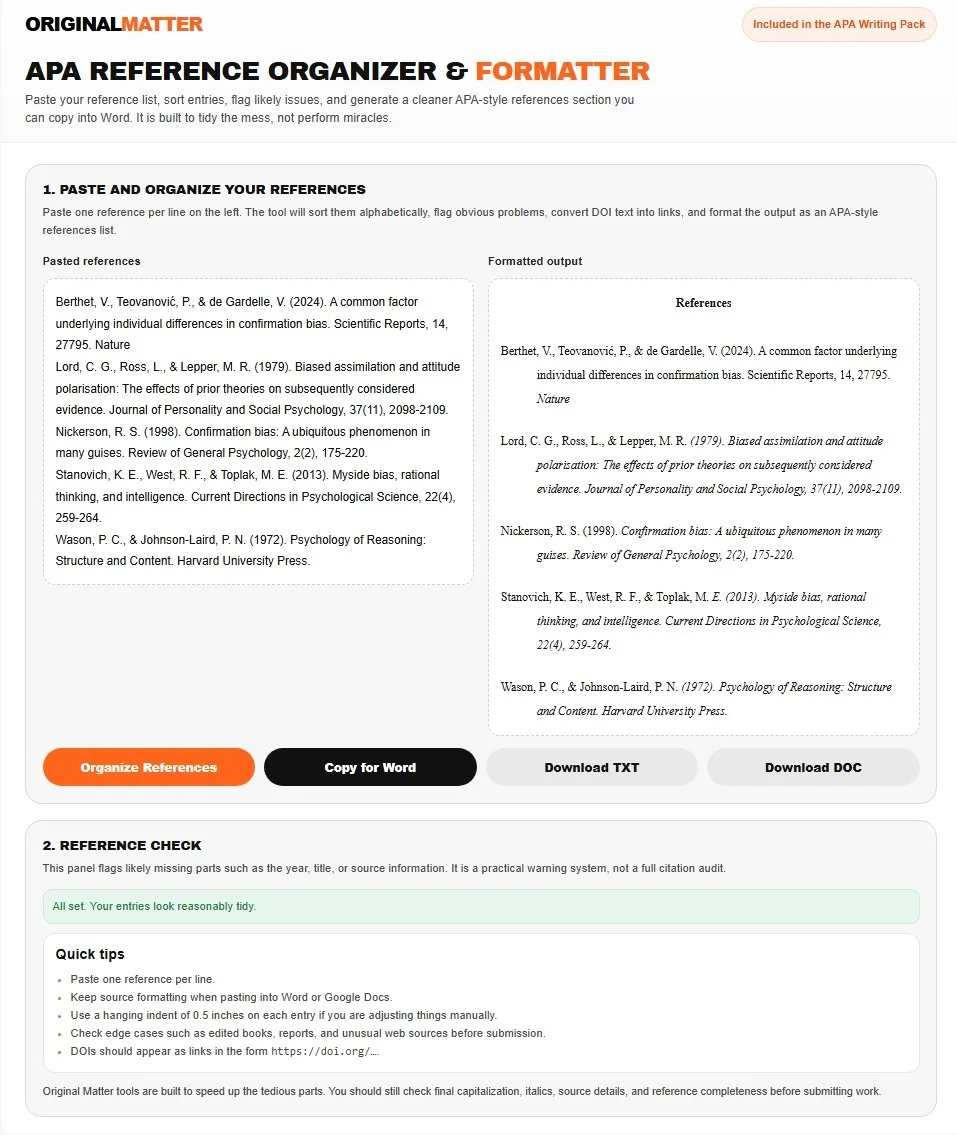
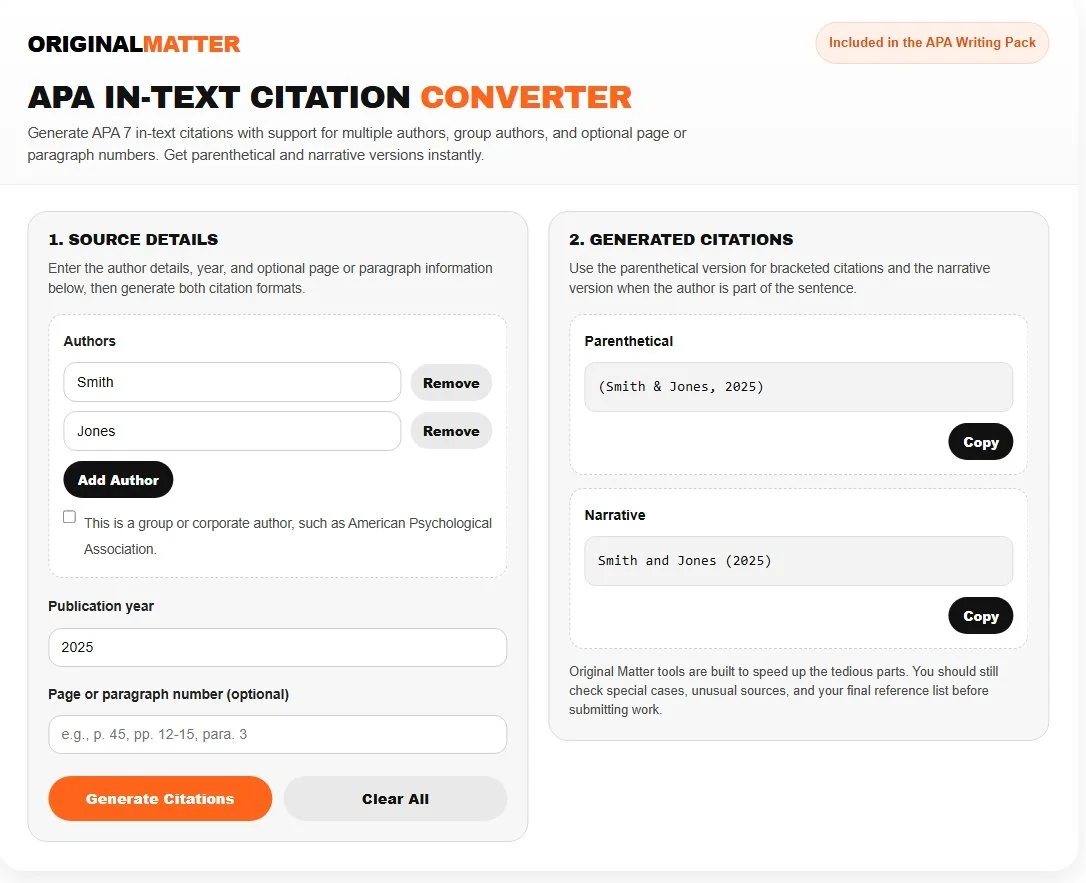
Our Complete Tool kit brings together Original Matter’s citation, reference, and formatting tools in one place, so you can spend less time wrestling with reference lists and more time finishing the work that actually matters
References
American Psychological Association. (n.d.). Basic principles of citation. APA Style.
American Psychological Association. (n.d.). Secondary sources. APA Style.
Purdue OWL. (n.d.). In-text citations: Author/authors. Purdue University.
Purdue OWL. (n.d.). Reference list: Other print sources. Purdue University.